News Story
Chellappa and Sundaresan awarded U.S. Patent for markerless motion capture
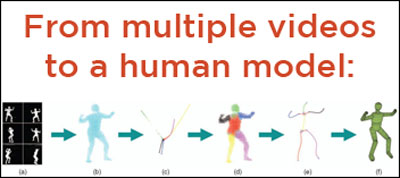
Fig. 1. Block diagram describing the steps in the segmentation in the LaplacianEigenspace (LE) to estimate the human body model. (a) Space carving to compute voxels. (b) Map to LE. (c) Bottom-up segmentation in LE. (d) Top-down registration. (e) Top-down model. (f) Pose estimation.
Minta Martin Professor of Engineering and Interim Chair Dr. Rama Chellappa and former student Aravind Sundaresan (Ph.D. 2007) have been granted U.S. Patent 8,023,726, “Method and system for markerless motion capture using multiple cameras”. A utility patent was issued on September 20, 2011.
Motion capture for humans describes the activity of analyzing and expressing human motion in mathematical terms. The task of motion capture may be divided into a number of systematically distinct groups, e.g. initialization, tracking, pose estimation, and gesture recognition.
The invention makes use of multiple cameras in capturing video sequences of a subject, feeding these sequences through data processing unit, and then creating a three-dimensional representation of the subject’s image. That image can be used to estimate the pose of the subject and will have applications in a variety of fields including kinesiology, bio-mechanics, surveillance, human-computer interaction, animation and video games.
There is a correspondingly large body of developments on human motion analysis and pose estimation from video data. However, the requirements in terms of the detail of pose parameters and accuracy in estimation vary from application to application as does the form of the available input data. Surveillance applications, for instance, usually require just the location of the subject or an approximate estimate of human pose from a single video stream, whereas bio-mechanical applications require detailed pose estimation, including different joint angles, from images obtained using multiple video cameras. Bio-mechanical and clinical applications require accurate capture of normal and pathological human movement without the artifacts associated with current state of the art marker-based motion capture techniques.
This invention will provide a markerless motion capture system using multiple cameras to acquire video sequences of a subject and automatically processing the acquired video data in an efficient fashion to result in an accurate estimate and presentation of the subject model and poses of some complexity. The research of Drs. Chellappa and Sundaresan was funded by the NSF, Contract No. IIS0325715.
More information on the invention can be found at the U.S. patent website.
Published October 1, 2011
Recent Stories
Stories / Jun 22, 2026
ECE Alum Levi Burner (Ph.D. '25) awarded prestigious...

Stories / Jun 18, 2026
ECE Professor Kaiqing Zhang Receives Donald P. Eckman Award

Stories / Jun 2, 2026
Three ECE Students Honored with UMD Graduate Assistant Awards

Stories / Jun 1, 2026
ECE Recognizes 2026 Outstanding Teaching Assistants

Stories / May 28, 2026
ECE Names 2025-2026 Distinguished Dissertation Fellows

Stories / May 28, 2026
Generations of Graduates: A Full-Circle Celebration

Stories / May 26, 2026
ECE Faculty and Staff Honored by The Universities of Shady Grove

Stories / May 22, 2026
ECE PhD Student Sydney Overton Receives Ann G. Wylie...

Stories / May 20, 2026
Team Led by Professor Mohammad Hafezi wins UMD Invention of the...

Stories / May 20, 2026
Team Led by Professor Mohammad Hafezi wins UMD Invention of the...
