News Story
Students tour National Institute of Standards and Technology (NIST)
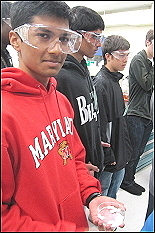
College Park Scholars freshman holds a Tissue Scaffolding sample at NIST, Oct. 14, 2010.
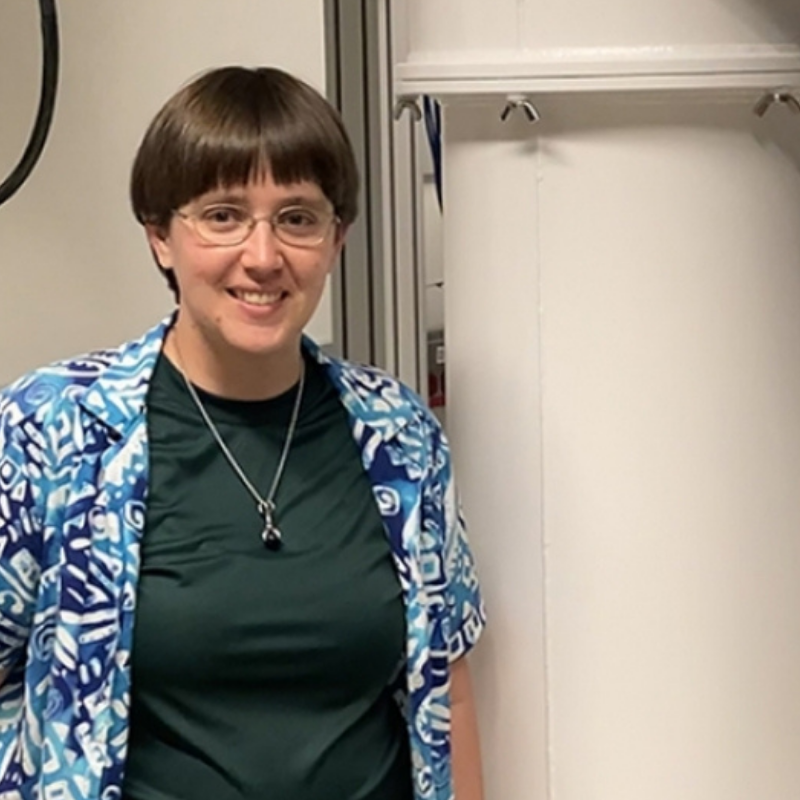
"I discovered a summer internship opportunity."
Lisa Fronczek encouraged students to compete for the Summer Undergraduate Research Fellowship (SURF) program at NIST, where the National Science Foundation funds about 100 fellows annually. All UM students submit their SURF applications through Heidi Sauber in Engineering Co-op and Career Services; the university deadline is early next semester, so by December students must start their application and identify two faculty to write recommendations.
Research at NIST
Tissue scaffolding is a fibrous surface on which the body can grow tissue of a particular kind and shape. In the Materials Measurement Laboratory (MML), Dr. Carl Simon explained that tissue scaffolding for bone is the most commercial, and that its market has grown enormously; scaffolds for organs and other tissues are in development. NIST's research characterizes the commercial products that are sold by a dozen firms, in order to increase the utility and standardization of the scaffolds. Ultimately, scaffolds support the body's attempt to grow tissue effectively, reducing the use of painful bone grafts, and giving the body new capabilities to heal.
The nanotechnology research explained by Dr. Dave Holbrook characterizes materials that are effective for remediating accidental spills of nano-particles into the environment. His research in Surface and Microanalysis Science, within the MML, also characterizes the ways that microorganisms eat, bioaccumulate, and excrete nano-particles. As with a wide range of significant industrial materials, the federal government regulates the handling and disposal of synthetic particles such as carbon nanotubes. Carbon nanotubes are studied to establish their physical properties and to integrate them into new forms of technology; research has only begun to characterize their interactions with human health, other forms of life, and the environment. Dr. Holbrook's research characterized the effectiveness of different types of metal fibers for removing carbon nanotubes from the water column of a river, a technique that is vital for reducing the risk inherent in carbon nanotube research and manufacturing.
The DNA Forensics laboratory, as described by Becky Hill, is a very active lab that sequences particular areas of DNA samples, with the ultimate goal of identifying an individual person. The lab's findings can become facts entered as evidence into judicial proceedings to establish the guilt or innocence of a defendant and to exonerate a person who has been convicted. Sequencing machines characterize a sample, and then seek to find a match in a very large database of DNA samples taken primarily from all people who serve in the military, who are convicted of a crime, or who supply a DNA sample for another reason.
More STS Field Trips
This free field trip was organized by the University Certificate program in Science, Technology and Society, and was open to any member of campus. It was one in a series of three trips funded by the program this fall; the other trips toured the Walter Reed Army Medical Center (Oct. 1) and the Army Research Laboratory, Adelphi (Nov. 3). For more information about the STS University Certificate program or about its field trips, email the director, Betsy Mendelsohn.
Published October 27, 2010
Related Stories
Stories / January 14, 2013
STEM service: January 2013 robotics workshop
Stories / April 11, 2012
17 Clark School Students Earn NSF Fellowships
Stories / October 26, 2010
Scholars students visit National Radio Astronomy Observatory
Stories / June 10, 2024
Teaching Students Specialized Skills for Success
Stories / January 18, 2024
Dutta to receive NSF CAREER Award

Stories / March 5, 2023
Abhinav Shrivastava Receives NSF CAREER Award to Advance...
Stories / February 7, 2023
Three UMD Faculty Elected to National Academy of Engineering
Stories / June 21, 2022
NSF RINGS: Harnessing the Complexity of Modern Electromagnetic...
Stories / January 27, 2022
Daniels Receives NSF CAREER Award
Stories / September 21, 2021
Kollár Receives NSF MRI Grant to Enhance Micro/Nanofabrication...