News Story
New Advance in Biochip Research
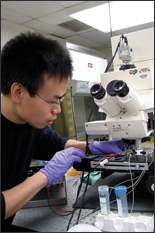
Xiaolong Luo, one of the graduate students working on this research.
"We have now demonstrated perhaps the key advance needed to realize what we seek, a powerful laboratory tool for drug discovery."
-- Gary Rubloff
After researchers placed an enzyme on a tiny "biochip" created to mimic the environment within the human body, the enzyme performed as it normally would. This means that the researchers can proceed to the next step--testing new drugs to see, for instance, how effectively they can inhibit bacteria like E. coli.
This advance builds on prior work by the team, which brings together expertise in bioengineering, biomolecular engineering, materials science, and electrical and computer engineering at the Clark School and the University of Maryland Biotechnology Institute (UMBI). The researchers have developed the biochip, a programmable biological microfactory, which will be used to test drugs and eventually deliver them where they are needed.
"We have now demonstrated perhaps the key advance needed to realize what we seek, a powerful laboratory tool for drug discovery," said Gary Rubloff, professor in the Clark School's Department of Materials Science and Engineering and Institute for Systems Research (ISR), director of the Maryland NanoCenter, and a member of the research team.
"Using biochip microfactories, we believe it will be possible to test potential drugs," Rubloff said. "We hope to enable scientists and physicians to create better, more effective drugs more rapidly and at reduced cost."
The microfactory allows the researchers to manipulate substances using fluid, electrical and optical means. For instance, the researchers used electrical voltage to place a substance called chitosan on the biochip. Chitosan serves as a platform for assembling biomolecules.
One targeted application of the microfactory is to develop drugs that can interrupt a process called "quorum-sensing."
In quorum-sensing, bacteria cells, such as E. coli, communicate with each other to form a quorum or group capable of creating an infection. The team has already demonstrated that it is possible to interrupt this quorum-sensing ability or to introduce new communication to ultimately prevent such infections.
Candidate drugs will be applied in the microfactory to test their ability to suppress or interrupt quorum-sensing. Drugs that succeed will not only serve as good candidates for new antibiotics, but they promise a new strategy for antibiotic therapy.
"Since the drugs won't kill the bacteria, the bacteria won't be stimulated to mutate, which renders too many antibiotics no longer effective, since the mutated bacterial strains are not killed any more by the original antibiotic," Rubloff said.
The team envisions the use of programmable biological microfactories as tools for rapid screening and development of new drugs prior to time-consuming, expensive clinical trials.
"Any lab screening that is faster or more efficient in identifying new drugs could also reduce drug costs and time to market," Rubloff said.
This development advances research funded by the Robert W. Deutsch Foundation and a National Science Foundation Emerging Frontiers in Research and Innovation grant of $2 million awarded to Rubloff; Greg Payne, director of the UMBI's Center for Biosystems Research; Reza Ghodssi, associate professor with the Clark School's electrical and computer engineering department and ISR; and William Bentley, Robert E. Fischell Distinguished Professor and chair of the Fischell Department of Bioengineering.
Results are reported in a recent issue of the journal Lab on a Chip (vol. 8, pp. 420-430, 2008). The Lab on a Chip paper is available online: http://www.rsc.org/Publishing/Journals/LC/article.asp?doi=b713756g
A related press release on this project is available online.
Published April 7, 2008
Related Stories
Stories / February 18, 2015
Maryland inventors issued US Patent for compounds that fight...
Stories / August 31, 2006
$1 Million For Nano-Bio Initiative
Stories / Jun 18, 2026
ECE Professor Kaiqing Zhang Receives Donald P. Eckman Award

Stories / Jun 2, 2026
Three ECE Students Honored with UMD Graduate Assistant Awards

Stories / Jun 1, 2026
ECE Recognizes 2026 Outstanding Teaching Assistants

Stories / May 28, 2026
ECE Names 2025-2026 Distinguished Dissertation Fellows

Stories / May 28, 2026
Generations of Graduates: A Full-Circle Celebration

Stories / May 26, 2026
ECE Faculty and Staff Honored by The Universities of Shady Grove

Stories / May 22, 2026
ECE PhD Student Sydney Overton Receives Ann G. Wylie...

Stories / May 20, 2026
Team Led by Professor Mohammad Hafezi wins UMD Invention of the...

Stories / May 20, 2026
Team Led by Professor Mohammad Hafezi wins UMD Invention of the...

Stories / May 13, 2026
Capstone Design Expo 2026: Students Solve for Maryland & Beyond
